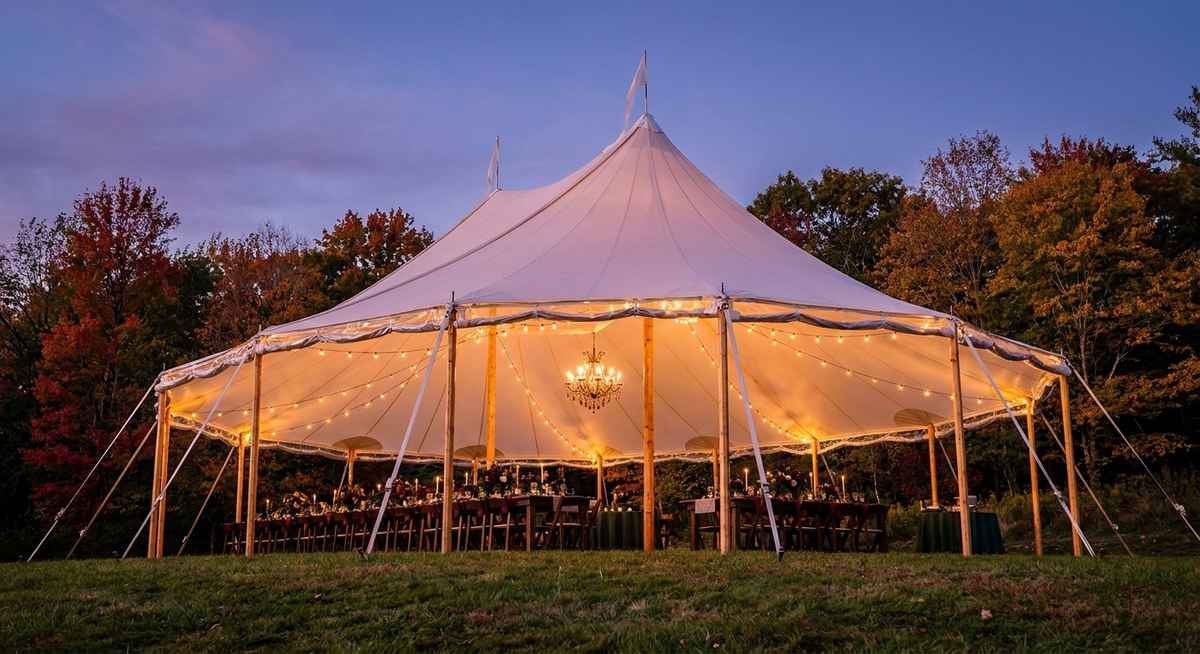
Not every tent comes down on Sunday morning. Across Eastern Pennsylvania, New Jersey and Delaware, more organizations are using engineered tent structures as semi-permanent space — for months, seasons, or the length of a construction project. Restaurants extending seating through the cold months. Warehouses that outgrew their footprint. Schools and hospitals adding covered capacity. Contractors who need weather-tight staging on a jobsite for a full build cycle.
A long-term tent rental is a fundamentally different product from a weekend party tent, and it is worth understanding why before you request a quote.
What Counts as a Semi-Permanent Tent Structure
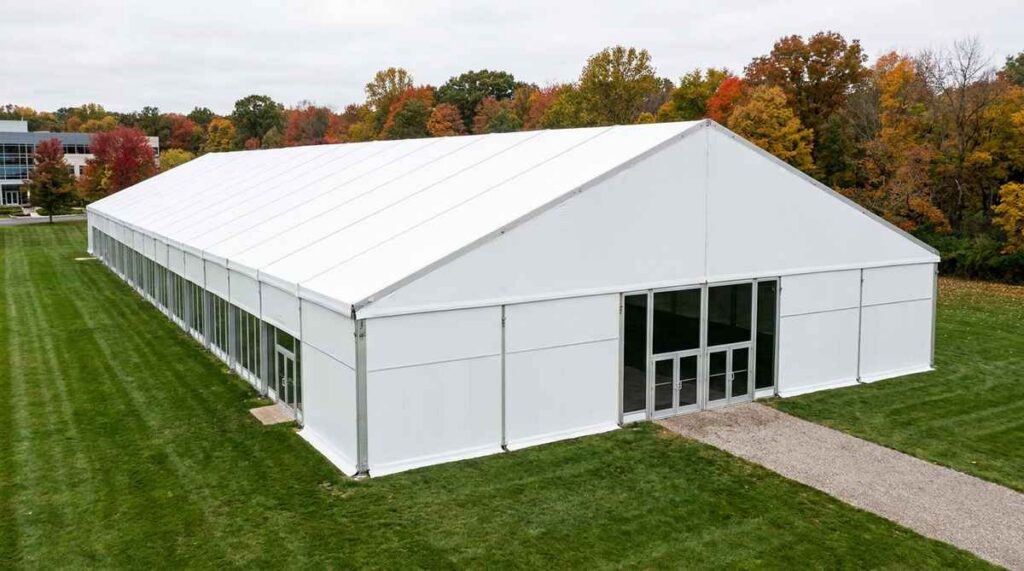
The industry term for the hardware is a clear-span structure tent — an aluminum-framed building with no interior poles, engineered to hold up under sustained wind and weather loads rather than a single afternoon of good luck.
Because there are no center poles, the entire footprint is usable. Solid walls, glass doors, hard flooring, HVAC and electrical distribution can all be integrated. Spans run from modest widths up to large-format buildings, and lengths extend in bay increments, which means the structure can be sized to the space you actually have.
Explore our structure tent inventory to see the range.
The Applications We See Most
- Seasonal dining and hospitality — enclosed, heated outdoor seating that runs from October through spring
- Construction and industrial — weather protection for materials, equipment and crews, covered in our construction expertise
- Warehousing overflow — temporary storage capacity without a lease or a build
- Institutional and medical — screening areas, overflow capacity, covered queuing
- Government, military and emergency response — long-duration deployments where the timeline is not fixed
- Sports and recreation — covered courts, batting cages and practice space through the winter
Engineering and Permits: The Part People Underestimate
This is where a long-term rental separates itself from a party tent, and where a lot of projects stall.
Engineering documentation. Only tents with stamped drawings from a licensed structural engineer carry official wind and snow load ratings. For any permit-required installation, that stamped documentation is not optional — it is the basis on which the permit is issued. Engineered structures typically certify to wind loads in the 70–90+ mph range with specified snow load capacity, and the ratings are conditional on the anchoring method actually used on site.
Fire code. Tent fabric must meet NFPA 701 flame-propagation standards. Requirements around exits, aisle widths, occupancy and fire extinguisher placement come from the International Fire Code, published by the International Code Council, and are adopted and enforced locally.
Building code. Pennsylvania administers construction code through the Department of Labor & Industry, with municipal code officials serving as the authority having jurisdiction. Occupancy classification, egress and structural review all apply once a tent stays up beyond a short-term threshold.
Anchoring. Stakes, ballast, concrete anchors — the method depends on the surface, the soil and the load calculation. Anchoring on asphalt over a parking deck is a different engineering problem than staking into a lawn, and it needs to be resolved before the crew arrives.
Snow. Any structure standing through a Pennsylvania winter needs a snow plan: either a heated interior maintained above a set temperature so accumulation sheds, or a documented removal protocol. This is the single most common oversight on multi-month installs.
We provide stamped CAD drawings for permitting, which is usually the fastest path through a municipal review.
Climate Control Is What Makes It Usable
A structure without conditioned air is a covered space, not a room. For any installation running through fall and winter in the Philadelphia metro, heating is what determines whether the investment actually returns anything.
Our approach pairs indirect-fired heating units sized to the volume of the structure with insulated liners where appropriate, and cooling for warm-weather deployments. Power distribution and generators can be specified alongside so the whole system runs independently of building service if needed. See the full range under event products.
Heating also solves the snow-load problem — a maintained interior temperature keeps accumulation from building on the roof fabric.
Budgeting a Long-Term Install
Long-term pricing works differently from event pricing. Instead of a per-event rate, a semi-permanent installation is typically structured with an installation and engineering component plus a monthly rate that declines over the term. Factors that move the number:
- Span and length — wider spans require heavier framing
- Term length — longer commitments lower the effective monthly cost
- Site conditions — grade, surface and anchoring method
- Sidewalls and doors — solid, glass, insulated, or a mix
- Climate control — unit sizing, fuel and runtime
- Flooring — from ground protection to full subfloor and finished surface
- Permitting support — drawings, calculations and jurisdiction coordination
For most clients, the comparison is against leasing conventional space or accelerating a construction schedule. On that basis, a structure tent frequently wins on both cost and speed.
Lead Time Matters Right Now
We are in the window where fall and winter installations get locked in. Engineering review, permit approval, site prep and crew scheduling all take real calendar time, and inventory for large-span structures is finite across the region. Projects that start the conversation in late August install comfortably. Projects that start in October compete for what is left.
Let’s Scope Your Structure
Thirty-plus years, tens of thousands of events, projects from $4,000 to well over $1 million. Tell us the footprint, the term and the use, and we will engineer it.
Request a long-term tent structure quote from EventQuip
EventQuip — 1084 Bethlehem Pike, Montgomeryville, PA 18936 — serving Eastern PA, NJ and DE — https://www.eventquip.com