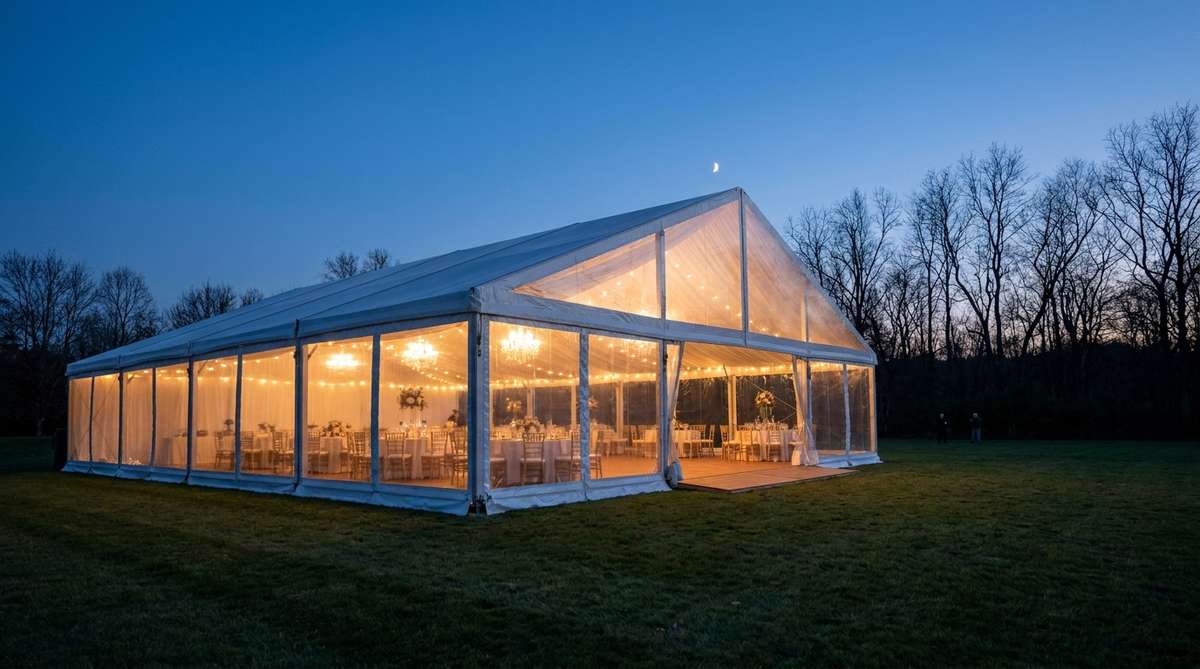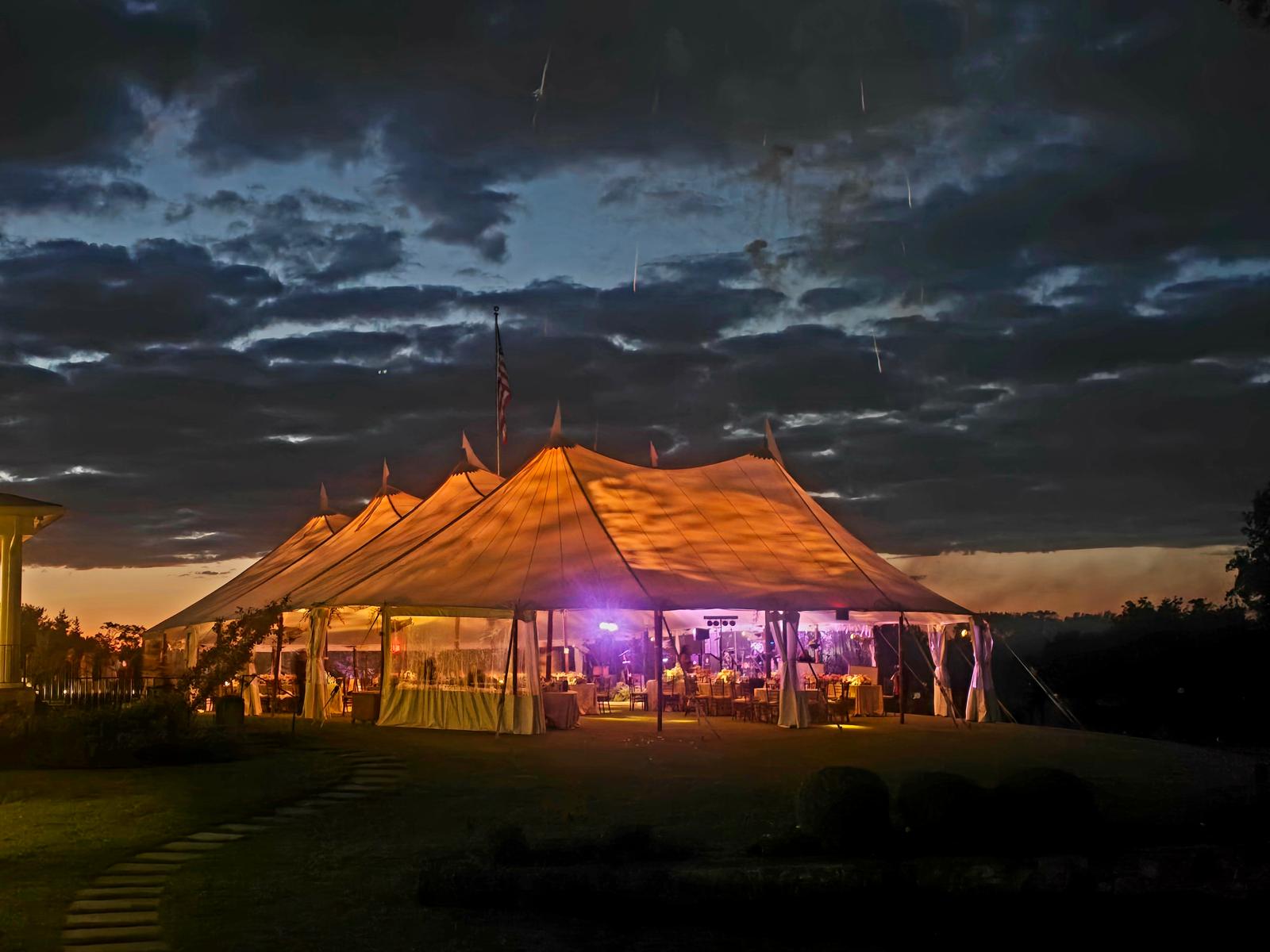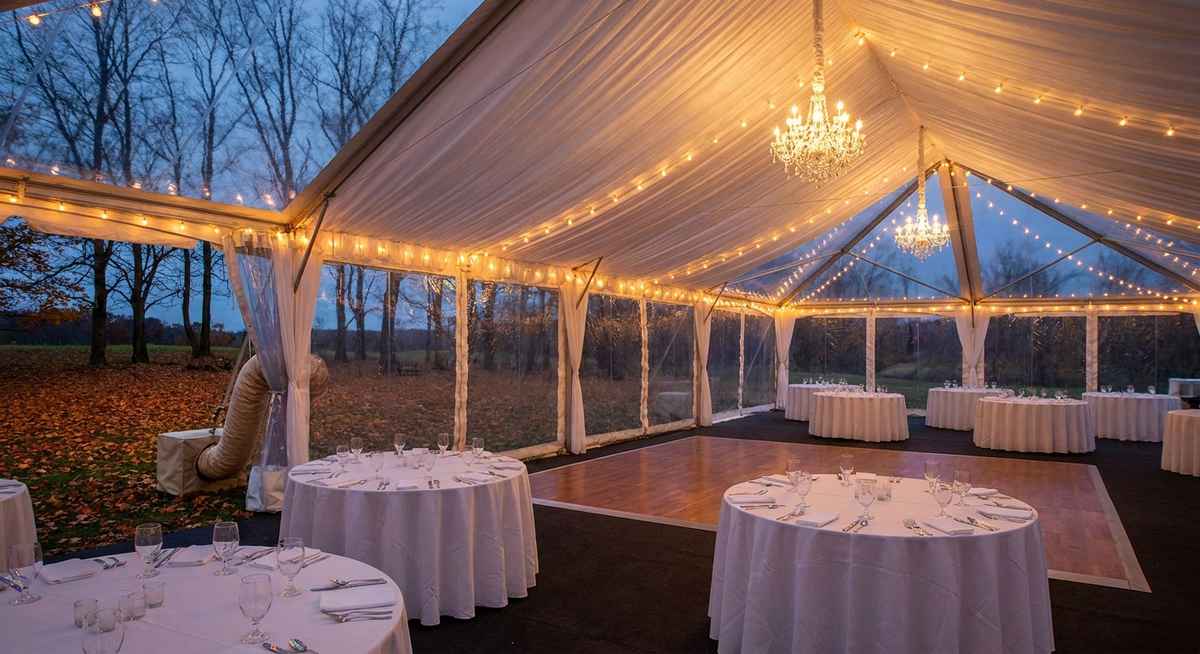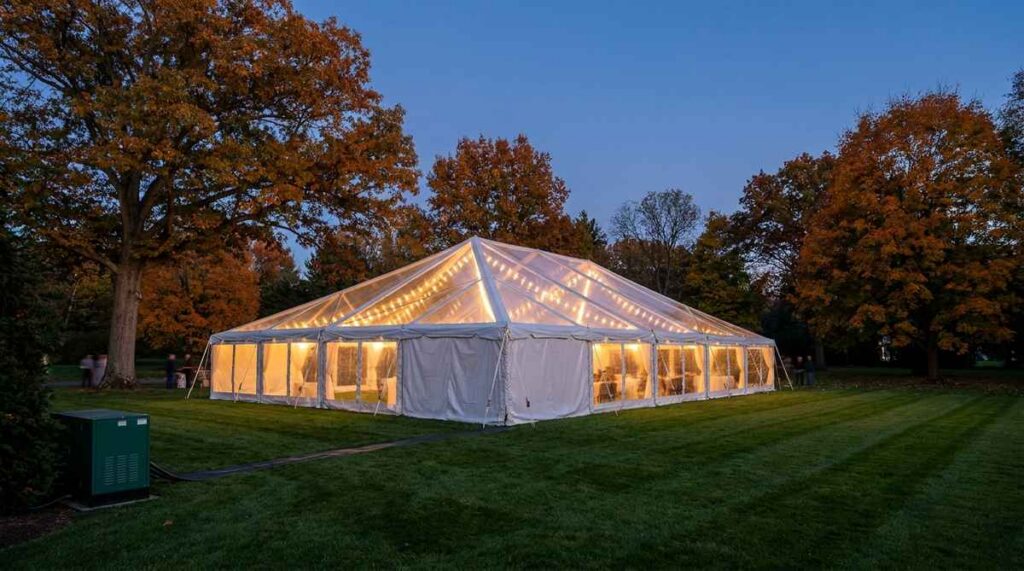
Fall is the busiest tented season in Eastern Pennsylvania, and it is also the season when the sun sets during cocktail hour instead of after dessert. A tent that looked flawless at a 2 p.m. site visit can feel like a parking lot at 6:30 p.m. in October — unless the lighting and the power behind it were designed at the same time as the tent.
Search demand for event tent rentals peaks in August and September, which means the calendar is filling now. Here is how to get the lighting and power right before it does.
Fall Changes the Math on Lighting
Between late September and early November in the Philadelphia region, usable daylight collapses by roughly two hours. That single fact reshapes three decisions:
- Timeline. Your ceremony, speeches or ribbon-cutting now happens in transitional light, not full sun. Photography and video need supplemental fixtures earlier than a summer event would.
- Fixture count. A tent that borrows ambient daylight in July needs its own light source in October — for the interior, the entry, the perimeter walkways and the parking path.
- Egress and safety. Guests arriving and leaving in the dark need lit paths, marked steps and lit restroom routes. This is a liability issue, not a design flourish.
The practical approach is layered: a base layer of even ambient light so people can read a menu and see each other’s faces, an accent layer that shapes the space, and a functional layer for paths, entries, kitchens and back-of-house.
The Layers That Make a Tent Look Finished
Ambient. Chandeliers, pendants, globe strands, or fabric-diffused fixtures suspended from the tent structure. This is the layer that determines whether the room feels warm or institutional. Dimmable is non-negotiable — you want a different level for dinner than for dancing.
Accent. Perimeter uplighting to wash the tent walls, pin spots on centerpieces and cake tables, and gobo or texture washes for branded corporate events. Uplighting is the highest-impact-per-dollar item in most tent lighting budgets.
Functional. Entrance and pathway lighting, catering tent work light, restroom trailer lighting, generator area lighting, and signage illumination. Guests never comment on this layer when it is done well and always notice when it is missing.
Our event products range covers the lighting, staging and flooring that sit underneath these decisions, and our tent options determine what can actually be rigged overhead — a structure tent carries a very different load than a pole tent.
Power: Do Not Assume the Building Can Carry It
The most common tented-event failure is not a lighting design problem. It is a power problem discovered at 4 p.m. on event day.
House power at a private residence, a historic venue or a construction site is rarely sized for a tent. Add climate control and the numbers move fast. A single tent heater, catering equipment, a band’s amplification, coffee urns and a lighting rig can easily exceed what a residential panel or a single venue circuit will tolerate — and the breaker will find out before you do.
The 2026 industry conversation around outdoor power has shifted toward efficiency: LED fixtures and modular systems that reduce generator load, quieter units, and in some cases battery or hybrid power for noise-sensitive sites. That is genuinely useful, but it does not eliminate the need for a load calculation.
A proper power plan accounts for:
- Total connected load, itemized by department — lighting, HVAC, catering, AV, restroom trailers, lifts.
- Startup surge, especially for heating and cooling equipment, which draws well above running load at startup.
- Redundancy for anything mission-critical — medical, government, or multi-day installations.
- Placement and noise. Generators need distance and screening from guest areas, plus safe cable routing.
- Fuel and runtime for the full event window, including load-in and strike.
Cable management deserves its own line item. Every run that crosses a guest path needs a cable ramp or to be routed under tent flooring — a taped cable on grass is a trip hazard and, after an evening of dew, a maintenance problem.
Carbon Monoxide and Generator Safety
This is the part that is not optional. Portable generators produce carbon monoxide, and tents are enclosed or semi-enclosed structures. The U.S. Consumer Product Safety Commission’s portable generator safety guidance is direct about keeping units well away from occupied and enclosed spaces, and OSHA’s generator and temporary power guidance covers grounding, GFCI protection and safe cable practice on work sites.
Combined with fall heating, this is exactly why generator siting, exhaust direction, and ventilation belong in the site plan rather than being decided by whoever unloads the truck. Our expertise page reflects three decades of doing this across weddings, corporate galas, construction sites, government installations and emergency deployments — the last two categories are where power redundancy stops being theoretical.
A Fall Lighting and Power Checklist
- Confirm sunset time for your event date and work backward through the timeline
- Decide dimming zones before you pick fixtures
- Light every path a guest will walk, including parking
- Itemize the full connected load, including heat
- Size the generator for surge, not just running load
- Plan generator placement for noise, exhaust and access
- Specify cable ramps or under-floor routing for every crossing
- Walk the site at dusk if at all possible
Let’s Plan Your Fall Event
Our checklist for success walks through the full planning sequence, and our portfolio shows how lighting and power come together at scale.
Request a quote for your fall tented event →
EventQuip — 1084 Bethlehem Pike, Montgomeryville, PA 18936 — serving Eastern PA, NJ and DE — https://www.eventquip.com