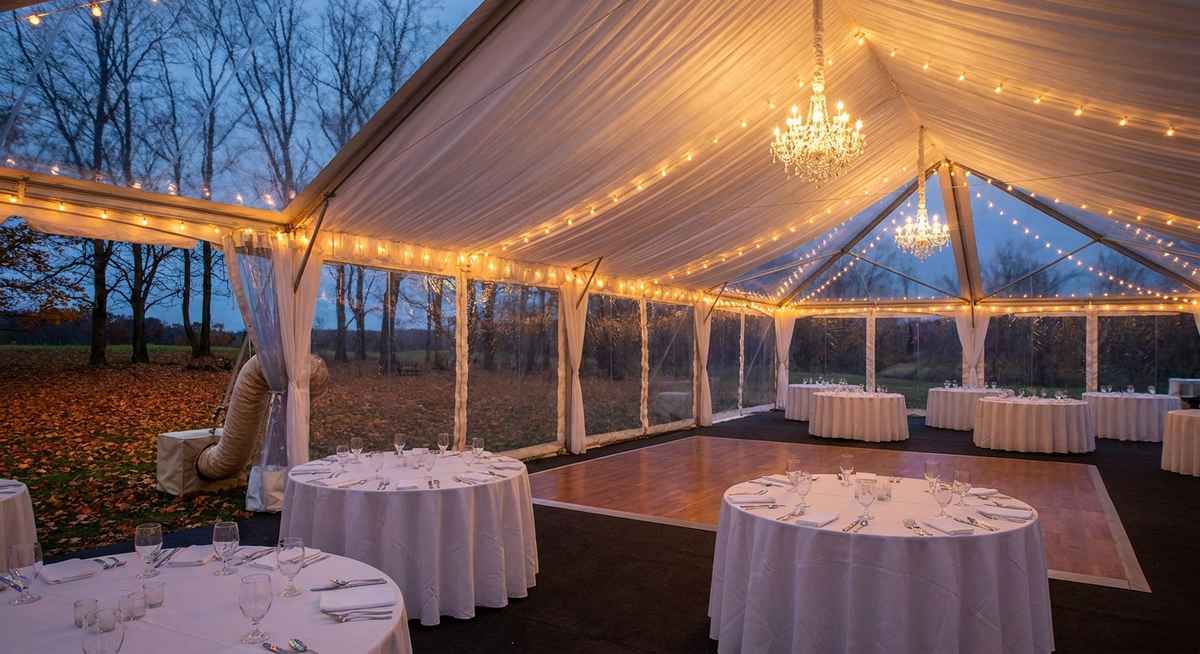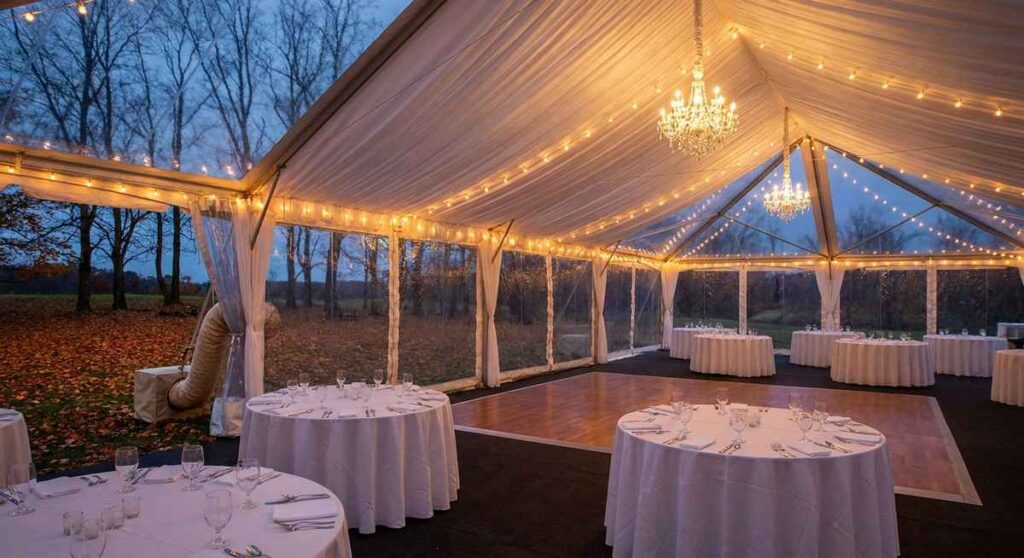
The calendar turns fast in the Delaware Valley. A tented event that felt effortless in September becomes a very different engineering problem by the second week of November — and by December, heat is not an amenity, it is the entire reason the event is possible. If you are planning a late-fall wedding, a corporate holiday party, a winter graduation, or an outdoor dining extension for a restaurant, the decisions you make in September determine whether your guests are comfortable in December.
Here is how heated tenting actually works, what it costs you to get wrong, and what to lock in now.
Why Fall Is the Booking Deadline, Not the Season
Search interest for event tent rentals peaks in late summer and early fall across the Philadelphia region — which means the best structures, the right heating packages, and experienced crews are being reserved right now for dates two and three months out. Heating equipment in particular is finite. There are only so many ducted heaters in the Delaware Valley, and December weekends consume them quickly.
The practical rule: if your event is between November 1 and the end of January, you want the tent, the heat, the flooring, and the power committed by early October. Waiting until the first cold snap means choosing from what is left.
Heat Is a System, Not an Appliance
The most common planning mistake is treating heat as a line item you add at the end. It is not. Heating a tent well depends on four things working together, and skipping any one of them wastes the others.
1. The tent itself. A structure tent with solid aluminum framing and tensioned fabric holds heat dramatically better than a pole tent, because the walls seal cleanly to the frame and there are no center poles interrupting the envelope. For any event where temperature is a design requirement rather than a nice-to-have, a clearspan structure is the right starting point.
2. Full sidewalls, properly sealed. Heat escapes at seams and at the ground line. Sidewalls need to be installed continuously, weighted or staked at the base, and zipped or clipped at every vertical seam. A single open corner will fight a heater all night.
3. Insulated flooring. Cold radiates up through grass and asphalt more than most planners expect. A raised subfloor or an insulated flooring system does as much for perceived comfort as several thousand BTUs of heat, because guests feel floor temperature through their shoes long before they notice air temperature.
4. The heater itself, sized and ducted correctly. This is where professional equipment separates from rental-yard patio heaters.
Indirect-Fired, Ducted Heat Is the Standard
For any occupied tent, indirect-fired ducted heaters are the correct choice. The combustion chamber sits outside the tent, exhaust is vented to the outdoors, and only clean warm air travels through insulated ducting into the space. This matters for two reasons: guest comfort, and safety.
Direct-fired heaters and open-flame patio heaters introduce combustion products and moisture into an enclosed space. NFPA 102, the standard covering tents and membrane structures, along with local fire marshal requirements across Montgomery, Bucks, Chester, and Philadelphia counties, governs how heating appliances may be used in and around occupied tents. Requirements vary by jurisdiction and by occupancy load, and a permit inspection is common for larger winter events. This is not a place to improvise.
The U.S. Fire Administration publishes general guidance on portable heating equipment that reinforces the same principle: separation of combustion from occupied space, clearance from combustibles, and proper fuel storage.
Practical placement notes:
- Heaters sit outside the tent, with ducting entering through a purpose-made sidewall port
- Fuel — usually propane — needs a defined, protected, accessible location
- Duct runs should be as short and straight as the site allows
- Distribution matters as much as capacity: two smaller units on opposite ends outperform one oversized unit at one end
Sizing: What Actually Drives the Number
Heating load depends on tent volume, sidewall coverage, outside design temperature, wind exposure, and guest count — guests themselves contribute meaningful heat, which is why a full tent runs warmer than an empty one and why a cocktail hour with the walls open behaves nothing like a seated dinner.
Rather than a rule of thumb, the honest answer is that this should be calculated for your specific date, site, and headcount. Our team works through it as part of the climate control and HVAC planning process, including cooling for the shoulder-season events where a warm November afternoon turns into a cold evening in the same four-hour window.
Power: The Constraint People Discover Too Late
Heaters need power. So do lighting, catering, band or DJ, and any warming equipment in the kitchen tent. Venue power is almost never adequate for a winter tented event, and the failure mode is not a dim room — it is a tripped circuit that takes the heat down along with the lights, in December, with 180 guests seated.
Plan generator and power distribution as its own workstream, with load calculated across every vendor. Ask your caterer and your production team for actual amperage draws rather than estimates. Build in headroom.
Lighting Changes Everything in Winter
Sunset in the Philadelphia area falls before 5:00 p.m. from early November through late January. That means the great majority of your event happens after dark, and event lighting stops being decorative and becomes the primary way guests experience the space. Warm-toned lighting also makes a tent feel meaningfully warmer than cool-toned lighting at the same temperature — a small design decision with an outsized comfort effect.
Who This Serves Best
Heated tenting is not only a wedding product. In practice, the strongest late-season use cases across Eastern PA, New Jersey, and Delaware are:
- Corporate holiday parties where indoor venue capacity is limited
- Winter and mid-year university graduations needing weather certainty
- Restaurant and brewery seating extensions running November through March
- Construction and industrial sites requiring enclosed, heated work or storage space
- Municipal and emergency operations needing rapid enclosed capacity in cold weather
Each of those has different priorities — a construction enclosure cares about durability and heat retention; a gala cares about ceiling treatment and lighting. Our expertise pages break down how the approach shifts across event, corporate, construction, military, and emergency work.
A Short Planning Checklist for a Winter Tent
Before you sign anything, you should have answers to these:
- Confirmed date, guest count, and seating format
- Site survey — surface type, slope, access for equipment, overhead obstructions
- Utility locate completed before any staking
- Tent type and sidewall plan
- Flooring specification
- Heating load calculated, with unit placement and fuel plan
- Total electrical load with generator sizing and distribution
- Lighting design for a fully dark event
- Permit and fire marshal requirements confirmed for the municipality
- Weather contingency and load-in/load-out schedule
Our checklist for success walks through this in more detail, and the tent terminology guide is worth a read if the vocabulary is new.
Lock In Your Date Before the Calendar Fills
The Delaware Valley’s late-fall and holiday tent inventory books earlier every year, and heating packages go first. If your event is anywhere between November and February, now is the moment to have the conversation.
Request a quote for your heated tent event
EventQuip — 1084 Bethlehem Pike, Montgomeryville, PA 18936 — https://www.eventquip.com